
Example 4 - Co-Production in Ward 113
Why they chose to focus on this:
I chose to focus on this area because effective communication is fundamental to delivering safe, compassionate, and person-centred care. The work was inspired by Dr Kate Granger's #HelloMyNameIs campaign, which highlighted the importance of healthcare professionals introducing themselves and building meaningful connections with patients. I wanted to understand whether our patients knew who was responsible for their care and whether our communication was meeting their needs.
Background
The initiative originated from Tracy Mellor, who developed the "5 Patients, 5 Questions" approach whilst working as a Ward Sister. She later shared the methodology with me when I became a Ward Manager. The concept was simple but powerful: regularly speaking with patients and asking a small number of focused questions to gain real-time feedback about their experience of care.
What was your aim?
My aim was to assess the quality of our patient communication and identify opportunities for improvement. Specifically, I wanted to understand whether patients knew who was caring for them and felt involved in their care journey.
I also wanted to:
Measure the effectiveness of staff introductions.
Improve patient experience and engagement.
Promote the principles of the #HelloMyNameIs campaign.
Use patient feedback to drive meaningful changes in practice.
Strengthen person-centred care across the ward.
What tools did you use?
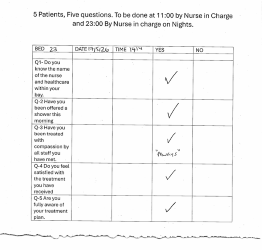
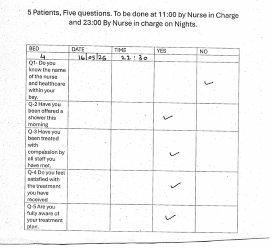
I used the "5 Patients, 5 Questions" audit tool to gather feedback directly from patients. This involved speaking to patients at the bedside and recording their responses to a standard set of questions.
The audit findings were then:
Analysed to identify themes and trends.
Shared with the ward team to raise awareness.
Used to inform improvement actions around staff introductions and communication.
Monitored through repeat audits and ongoing patient feedback.
The initial audit identified that 93% of patients did not know the name of the staff member looking after them, providing clear evidence that improvements were needed. This data enabled me to engage the team, implement targeted interventions, and reinforce the importance of introducing ourselves to every patient, every time. The initiative ultimately supported improvements in communication, patient experience, and the quality of care delivered on the ward.
What did they do? When, where and for how long?
As a Ward Manager, I implemented the "5 Patients, 5 Questions" initiative on my ward to assess the quality of communication and patient experience. The initiative was inspired by Dr Kate Granger's #HelloMyNameIs campaign and was shared with me by Tracy Mellor, who had originally developed the approach as a Ward Sister.
The audit was undertaken over a one-month period, during which I conducted patient interviews twice a day. Each day, I spoke directly with a sample of patients on the ward and asked the same five questions about their experience of care. This allowed me to gather real-time feedback from a broad range of patients and identify any recurring themes or concerns. The information collected was reviewed and analysed throughout the month. One of the key findings was that 93% of patients did not know the name of the member of staff responsible for their care. This highlighted a significant gap in communication and patient engagement.
Following the audit, I shared the findings with the ward team and led discussions on how we could improve. We reinforced the principles of #HelloMyNameIs, encouraged consistent staff introductions, and increased focus on ensuring patients knew who was caring for them. The initiative helped raise staff awareness, improve patient communication, and strengthen our commitment to person-centred care.
By undertaking the audit consistently twice daily for one month, I was able to collect robust patient feedback, use evidence to drive improvement, and demonstrate the positive impact that small changes in communication can have on the patient experience.
How did you engage with the team and service users?
Engagement with both the ward team and service users was central to the success of the initiative.
With service users, I personally conducted the "5 Patients, 5 Questions" audit twice daily over a one-month period, speaking directly with patients at their bedside. This approach allowed patients to share honest feedback about their experience and gave them a voice in shaping improvements to care. By listening to patients and acting on their feedback, they became active partners in the improvement process.
With the ward team, I shared the purpose of the initiative from the outset, explaining the link to Dr Kate Granger's #HelloMyNameIs campaign and the importance of understanding the patient experience. Once the audit findings were available, I presented the results to the team and facilitated open discussions about the barriers to effective communication and the impact this could have on patients.
The finding that 93% of patients did not know the name of the staff member caring for them created a strong sense of ownership among the team. Together, we identified practical actions to improve introductions and patient engagement. These discussions took place during handovers, safety huddles, team meetings, and informal ward conversations, ensuring that communication remained a visible priority.
I maintained engagement by regularly sharing feedback, celebrating improvements, and encouraging staff to reflect on how small changes, such as introducing themselves and displaying their names clearly, could have a significant impact on patient experience. This collaborative approach helped create a culture where both staff and patients were involved in driving and sustaining improvement.
What impact did you have? How did you know change was an improvement?
To support and sustain these improvements, I worked with the team to introduce a practical solution. We ordered new bedside patient boards for every bed space, which display the patient's name and the names of the nurse and healthcare professionals caring for them. This provides patients and their families with a clear visual reminder of who is responsible for their care and helps staff keep this information updated throughout each shift.
I knew the changes were making a difference because:
The audit identified a clear baseline from which improvements could be measured.
Staff became more engaged and conscious of introducing themselves to patients.
Patients were better informed about who was caring for them.
Communication and patient engagement became a regular focus during handovers and team discussions.
The introduction of the new bedside boards provided a sustainable change that supported both patients and staff.
Most importantly, this work strengthened person-centred care by ensuring patients felt recognised, informed, and more involved in their care. It demonstrated how listening to patient feedback, engaging staff, and implementing practical solutions can result in meaningful and lasting improvements.
What was your key learning? Next Steps, plan to roll out more widely?
My key learning was that small changes in communication can have a significant impact on the patient experience. As healthcare professionals, we may assume that patients know who is caring for them, but the audit demonstrated that this was not always the case. The finding that 93% of patients could not identify the member of staff responsible for their care highlighted the gap between what we believed was happening and the reality experienced by patients.
The project reinforced the importance of:
Listening to patients and using their feedback to drive improvement.
Using data to challenge assumptions and identify opportunities for change.
Engaging staff in solutions rather than focusing on problems.
Ensuring that compassionate communication is embedded in everyday practice.
Recognising that person-centred care starts with something as simple as introducing yourself and explaining your role.
I also learned that sustainable change is more likely to be achieved when improvements are supported by practical tools and visible reminders.
Next Steps / Plan to Roll Out More Widely
To ensure the improvements are sustained, we have invested in new bedside patient information boards for every bed space, which will clearly display:
The patient's name.
The name of the registered nurse caring for them.
The names of key members of the multidisciplinary team involved in their care.
The next steps are to:
Continue auditing patient awareness of their care team through regular patient feedback.
Monitor the use and completion of the bedside boards.
Share the audit findings and learning across other wards and departments.
Present the project as an example of good practice within divisional and organisational quality improvement forums.
Encourage other clinical areas to adopt the "5 Patients, 5 Questions" approach to assess and improve communication with patients. (Examples here and here)
Align the initiative with the ongoing principles of #HelloMyNameIs and person-centred care.
By spreading the learning more widely, I hope to support a culture where every patient knows who is caring for them, feels involved in their care, and has a more positive healthcare experience. This project demonstrated that a simple question can lead to.