Skip to main content Skip to footer

Testosterone (Referred)

Test Alias / Common Abbreviations


Testosterone by mass spectrometry


Department


Biochemistry (referred to external laboratory)
Department of Clinical Biochemistry, Level 2, Turnberg Building, Salford Royal Hospital, Stott Lane, Salford, M6 8HD.


Pre-analytical information  


Add-on requests: NA

Minimum Retest Interval: NA


Sample  Collection instructions:


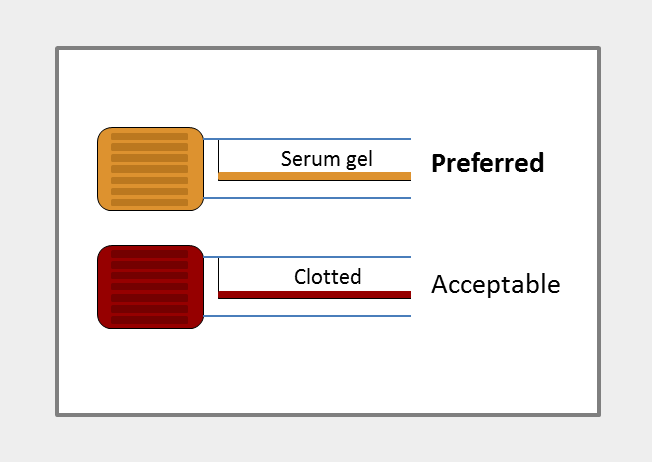
Collect the blood sample using normal venepuncture technique into a serum gel/plain serum tube.

Note, this test is note directly reusable by users. It is added by the laboratory when required, or on the request of a specialist via direct discussion with the Duty Biochemist.


Sample Transport & Stability Information:


Samples should be sent to the laboratory on the same day as collection to ensure sample integrity is maintained.  If a delay in receipt of the sample is anticipated, please contact the laboratory to discuss storage requirements.

For generic information on test requesting, sample labelling and packaging, and sample transport – see the frequently asked questions here.


Sample Type, Container & Volume

Adult sample type:


Paediatric sample type:

Plain serum


Turnaround Time

Based on receipt at testing site.

Within 4 weeks.



Please access the referral laboratory website/laboratory handbook for information on reference ranges. Where required, reference ranges and/or interpretative comments provided by the external referral laboratory may be added to reports alongside results.

Results outside the reference range do not necessarily indicate disease. Similarly, results within the reference range do not preclude abnormality. Please contact the Duty Biochemist for discussion of individual patient results.

Used to confirm elevated testosterone concentration in females, and in investigation of suspected immunoassay interference (all patients). The external laboratory uses a more specific method for testosterone (mass spectrometry) compared to the routine in-house assay (immunoassay).

Samples for female patients will routinely be referred for mass spectrometry if the testosterone by immunoassay is ≥2 nmol/L and/or the free androgen index (FAI) is raised. Exceptions may be made for patients know to be on exogenous testosterone (e.g. HRT), or if raised testosterone has previously been confirmed by mass spectrometry.

There are a number of non-pathological factors that can influence levels of specific analytes, giving falsely elevated or reduced levels. If you require more information regarding the effects of these factors on the individual test results, please contact the Duty Biochemist.

For tests performed at an external referral laboratory, consider contacting the performing laboratory directly for specialist advice on the interpretation of results.

Serum/plasma samples are routinely screened for the presence of haemolysis, icterus and lipaemia. Results are not reported if one or more of these has been detected at levels deemed to have had a significant impact on the accuracy of the test.

Please indicate which panel of lysosomal enzymes is required, along with relevant clinical details. This information is crucial for guiding the most appropriate analysis. 

Reviewed / Updated On: 02/12/2025