
Target range is 5 – 20 mg/L
Phenytoin
Test Alias / Common Abbreviations
Not applicable
Department
Biochemistry
Royal Stoke University Hospital
Pre-analytical information
Add-on requests: accepted up to 48 hours post sampling
Minimum Retest Interval: n/a
Sample Collection Instructions:
Collect the sample using normal venepuncture technique into a serum gel tube (gold-top).
Samples should be taken pre-dose or >6 hours post dose.
Sample Transport & Stability Information:
Samples should be sent to the laboratory on the same day as collection to ensure sample integrity is maintained. If a delay in receipt of the sample is anticipated, please contact the laboratory to discuss storage requirements.
Stable in separated serum for 24 hours at room temperature, 2 days at 4-8oC and 5 months at -20oC.
For generic information on test requesting, sample labelling and packaging, and sample transport – see the frequently asked questions here.
Sample Type, Container & Volume
Adult sample type:
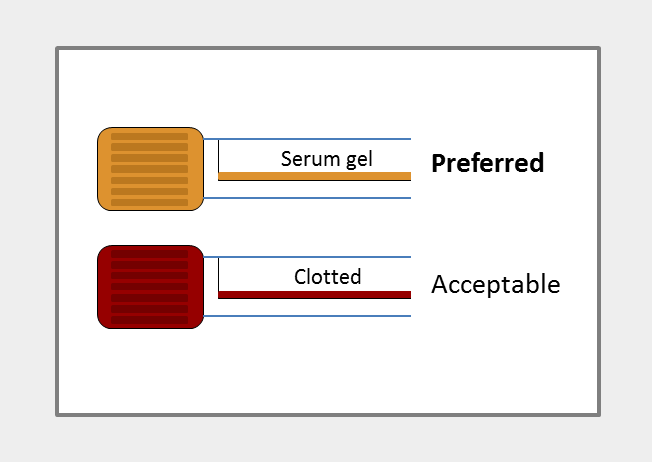
Paediatric sample type:
Plain serum
Turnaround Time
Based on receipt at testing site.
Within 24 hours.
The main indications for measuring phenytoin are: on initiating therapy, during i.v. therapy, unexpected deterioration in seizure control, as an adjunct to the diagnosis of toxicity, when interacting drugs are added or withdrawn and in pregnancy.
Factors that significantly affect result
Absorption of oral phenytoin is slow, sometimes variable and occasionally incomplete; this is often related to the formulation used. Phenytoin metabolism is by CYP 2C9 which can be saturated within the reference range; the consequences of this are clinically important since there is a non-linear relationship between dose and plasma concentration. Approaching saturation, a small increase in dose or a change in metabolic capacity (e.g. illness, other drugs) may result in a large increase in serum phenytoin concentration and possible toxicity; the saturation point varies between patients. Clearance of phenytoin is increased in pregnancy.
There are a number of non-pathological factors that can influence levels of specific analytes, giving falsely elevated or reduced levels. If you require more information regarding the effects of these factors on the individual test results, please contact the Duty Biochemist.
Serum/plasma samples are routinely screened for the presence of haemolysis, icterus and lipaemia. Results are not reported if one or more of these has been detected at levels deemed to have had a significant impact on the accuracy of the test.
Phenytoin is an anticonvulsant used in the treatment of tonic-clonic seizures (Grand Mal) and complex (focal) seizures, status epilepticus, cardiac dysrhythmias and trigeminal neuralgia.
It is usually used in combination with other anticonvulsants. Intravenous phenytoin is effective in the management of status epilepticus, but benzodiazepines are safer and more frequently used.
For more information, please see the following: Phenytoin – Lab Tests Online.
Reviewed / Updated On: 24/10/2025